Friday, May 16, 2014


Robocop (1987) vs Robocop (2014)

Let me preface this by saying that I'm not a huge fan of the Robocop series. I do have some fixation on the first one as it was one those movies that as a child I knew I wasn't supposed to watch, and yet we always found a way to sneak in some R rated movies at my uncle's house over Christmas, with his surround sound, and ginormous 60 inch TV. Oh, those days of VHS.

So, I decided to revisit this movie of my childhood and compare it to the remake that recently came out. Admittedly, I had no desire to really see the remake, but thought it would be fun to see what the differences are between these two versions just for the heck of it.

First off, the cast of the new one is definitely better. Michael Keaton?!?! He's not dead! Gary Oldman is always a welcome addition to any movie. The other actors are pretty crappy, but I can't say any of the performances are incredibly memorable from the first Robocop, except for the actor who plans Boddicker, Murphy's killer.

I also like the way they brought the story for the remake into present day issues, dealing with drone strikes, and occupying foreign territory, with the help of these contractor type companies like Omnicorp. However, some of the political implications are so trite, or underdeveloped that they go missing later on, or they have obvious parodies of the right wing establishment, particularly with the The Novak Factor...whoops...I mean the Novak Element. Samuel L. Jackson actually makes for a decent O'Reilly if I do say so myself. Other elements of the remake also aren't written so well, with a very cliche family storyline that veers off of the original wildly. Dialogue is pretty bad throughout the movie with tough guy talk between cops and bad guys, and incredibly generic boardroom discussion taking place between the evil corrupt businessmen.  Plot devices are pretty transparent, and character motivations become a little murky throughout the movie. Although these weren't really strengths of the original to begin with. They're just worse than the original.

I do have to give the remake some props on the action scenes at least. They're not great, but they do have some quality, like a massive gun fight in pitch black, and a fight between Robocop and several giant robots, not unlike the one used in the original. There's something about the style that's not quite up to par with the original though. I remember watching Total Recall and Robocop at an early age, and being shocked at how violent, but stylistic the movie was. I'd never seen gun fights like that before, and they somehow managed to be realistic, artistic, a bit surrealistic, and yet not that disturbing at the same time.

Speaking of style, this is where the two separate the most. There's a tone to the original that is completely lost on this remake. Perhaps the director was purposely avoiding the winking satire of the original, but the remake is so self-serious, as to remove much of the fun of the original. Which begs the question, why remake it then? I know what you're thinking...for money, of course. That's what makes the remake so funny to me. Remakes are always made for money, and yet the message of the original and this one is the antithesis of the corporate Hollywood structure that produced this remake.

Whatever. Hollywood will do its thing I guess.

Thursday, May 1, 2014

The Amazing Spider Man 2


What can be said about the new spider man?
That it was Amazing?
Well that is in the title.
                It takes a special sort of a movie to cause someone to walk from the theater carrying a little bit of the characters burdens. Undeniably, this movie was great- it had those punchy one liners, great acting, amazing special effects, killer romance, connections that were so real. It was what a comic book movie should be-with a dash of a little unbelievable. But even that I can reconcile with. But it’s the feeling I’m still carrying from the theater. A feeling that stayed with me as I paid for parking, drove home and took a few moments to sit and think about the movie before sitting down to write about it.
I think Gwen Stacy had it right when she spoke of hope. That is one of the reasons people love these movies, outside of the grand special effects. Peter and Gwen, portray that youthful, hopeful, exuberance and chemistry throughout the movie. In fact, when it came down to the majority of the main cast I never once questioned their character or believability. But it was the hope all the characters carried and fought for, even Harry.
Dane DeHaan, being new to the on-set main liners, started and stayed strong. He found a niche for himself and made his character really come to life. He is different from the Harry Osborn I remember from reading the comics and the last classes (James Franco) portrayal. But I found I liked this Harry better. I enjoyed his story better. And over all I enjoyed Harry’s and Peter’s relationship better. It was more complicated and darker. Desperate. Desperate from both sides. And I loved that. It doesn’t hurt that both Garfield and DeHaan are quite the lookers comparatively.
Now I could wax on about how amazing the movie is, how Garfield and Stone create this aching sweet romance that rips at your innards, how DeHaan brings a surprising bit of empathy to the table, how Field brings out a protective streak and yet makes you want to give her a trophy for being one tough ol’ bird. Or even how the occupants of New York make you really want to stop and tell them that are incredibly idiotic for standing in the middle of a special powered show down. This movie really does it all to bring a little bit everything out, the good and bad, in all of us. The selfish, unselfish, friendship, love, family, extreme loss- coping. There is definitely a recurring theme of how people cope in this movie. And none of the characters are the same, and it’s so refreshing.
But I’m sure, since I have seen some of the titles of other blogs and reviews out there- the question comes to, where did they go wrong? And honestly. There was really only one disappointment for me. And that was in Jamie Foxx’s performance. His character, his story line, the acting- it feel flat. Which is ironic due to the fact that Electro and his electricity is what makes a lot of the sound track music. (Great idea -think the Sorcerer’s Apprentice circa 2010). When the movie started, I was digging the character. Not really completely buying the actor portrayal but definitely willing to ride the fence for a bit before making a decision. In the end, despite strong writing and characterization for the rest of the cast, Electro feel short. Now I will say there were gems amongst all that electricity. His first scene and his last scene as Max- the last scene does cause some resonance. But it’s lost with what becomes of the character later on. If I could change anything of the movie- it would be that portion.
I recommend this movie. I recommend Andrew Garfield. He is my favorite Spider Man and that was firmly cemented with this film. And I can only hold my breath waiting for the next one and hope it will be just as good, especially with all the changes it will need to carefully write in.

Wednesday, April 9, 2014

Captain America: The Winter Soldier (2014) dir. by Anthony and Joe Russo


Who is that? It's Captain America! Are you seriously that stupid?

Captain America: The Winter Soldier (or, since I'm lazy, CA:TWS) is the latest entry in Marvel's Cinematic Universe (MCU).  The MCU has now grown to the point where it is threatening to eclipse the Non-Marvel Cinematic Universe (NMCU). Soon, every other movie released will reside in the MCU. Disney has the MCU planned to the year 2028. They are hiring the best (nerd) directors available. Joss Whedon. James Gunn. Edgar Wright. The franchises are multiplying. At first there was Iron Man, and you were all, this is cool. Then The Incredible Hulk and Thor arrived and you were all, fine, I can keep up. Then Captain America: The First Avenger happened, and you might have been a little overwhelmed but you were willing to not stress out too much since the threads all connected with The Avengers, Joss Whedon's finest moment since the 'Hush' episode of Buffy the Vampire Slayer (not that I've seen Buffy or anything, let's change the subject).

Then there was more Iron Man, more Thor, more Captain America, and, coming this summer, another franchise: Guardians of the Galaxy. The TV show Agents of S.H.I.E.L.D. began to air. Netflix announced a deal to stream original series based in the MCU. Don't lie. You haven't seen everything set in the MCU, and you're never going to. As a completist, this fills you with extreme agony.

All of this is to say that it's difficult to evaluate CA:TWS on its own merits, and not as a larger part of an ongoing saga that will probably outlive human life on earth. Multiple story threads are developed, and some of them are given the "to be continued next time!" treatment. While this is understandable, after all, Disney is building a cash cow the size of the Andromeda Galaxy, it is a bit frustrating, and it leads to directorial choices that should feel spontaneous and instead come across as unspoken obligations. For example, the movie features TWO scenes that play after the movie is finished. While avoiding spoilers, I'll give you my immediate reactions.

FIRST CLIP PLAYS A FEW MINUTES INTO THE CREDITS: Wow! That was pretty cool. I wish they'd included it in the movie itself.

SECOND CLIP PLAYS AFTER THE CREDITS ARE OVER: Seriously. They should have just included this scene in the movie. I need to pee crazy bad.

I needed to pee crazy bad because CA:TWS is over two hours long, and that's before the credits start. I understand why Disney (or Marvel, or whoever is ultimately in charge of the MCU thing) is doing this. The films need to connect, and it adds to the excitement if fans can build anticipation for years on end based on brief after-the-credits clips. It is unfortunate, however, that this move undercuts the movie just seen. "Forget about the movie you watched! Start thinking about the next one!" goes the message.

Well, what about the movie itself? CA:TWS is pretty good. The characters are lively, their interactions are a carefully balanced blend of reasonable pathos and clever quips. The acting is serviceable.

The plot is wildly overcomplicated. There are twists and turns and a USB drive with information gleaned from somewhere by somebody through a series of convoluted moves for a reason that isn't clear on a first viewing and at some point it gets too confusing for you to care about. Ultimately the plot boiled down to: bad guys want to take over the world. Good guys must stop them. Once I had this dynamic straightened out in my mind, the details stopped mattering as much. In other words, don't be ashamed to turn off your mind. This isn't an effing Andrei Tarkovsky movie.

I did appreciate the fact that while the movie perhaps overreached itself in its spy thriller aspirations, it remained firmly rooted in comic book conventions and comic book reality. By this I mean that there is a scene in the movie where Black Widow asks Captain America about a recently encountered villain.
"He was fast, and strong," says Captain America. "And he had a metal arm."
At no point does Black Widow, who is played by Scarlett Johansson, respond, "Hold on a second. Did you say he had a metal arm? Like he had metal covering his arm?"
"No. His arm was entirely made of metal."
"And he could move it around like a regular arm and stuff?"
"Yeah."
"How high are you right now?"
Instead, she nods her head, like, of COURSE he had a metal arm. It all makes sense now. 

The comic book tone of the movie remains consistent and appreciated.

On a final note, the action scenes are awesome. Practical effects and stunts are used wherever possible. This means that when a semi-truck smashes into a police car, it isn't a crappy looking CGI truck crashing into a crappy looking CGI car. It's real, with steel crushing steel, and glass coursing through the air. The hand to hand combat suffers a little from an overly shaky camera, but is mostly comprehensible. Most importantly, the Russos go the extra mile to make the action sequences creative and fun. Stuff gets blown up and people get thrashed or killed in memorable, PG-13 ways. What more could you want?

Go see it. Or go see the credits so you can get excited about what you will be seeing later.

Score: 3.5 American Flags out of 5

Sunday, April 6, 2014

It's a train, It's bullet... It's a dud?


Man of Steel
D. Zack Snyder (2013)

Maybe I’m a little late jumping on this bandwagon. But as I watched Man of Steel for the third time last night I was struck by the bad writing, the random use of time, and the overbearing fight scenes. Don’t get me wrong here- I am a complete guy’s movie sort of a girl. Give me fast cars, big explosives, lots of fire, stunts that don’t seem real, two people slugging it out, pour a lil’ blood over it all for some fun, and I’m good-I’m happy. 

I think there is something intrinsically hard about doing an origin movie when anyone who has been alive for at least the past fifteen years probably already has a good idea of how most of the superheroes came to be. Superman’s story isn’t one of those mysterious ones that most people don’t know. Batman- he was rich, his parents were killed. Spiderman- bit by a radioactive spider. Green Lantern- chosen as a successor by a dying alien, given a ring. Superman- sent to earth by alien parents for survival. Admittedly there have also been a lot of superhero movies in the past few decades. So once again, it’s something we’ve seen before even if it didn’t come with all those nifty special effects. And in this case, Man of Steel, was relying heavily on these special effects. 

But let’s just take a moment here and talk a little bit about how they decided to construct and deconstruct time in the movie. I’m all for nonlinear time sequences but it has to a) make sense and b) use it for some greater purpose. Which, I really don’t see why time had to nonlinear in the movie. We open at the beginning with Jor-El and General Zod. And we get to find what’s going on in their world and that Jor-El and Faora-Ul had just had the first live brith in centuries due to population control. And we get some really some awesome fight scenes. Go Russel Crowe! So we wrap up Cal-El/Clark Kent/Supermans time with his parents and he’s sent to Earth and we watch the destruction of his planet. Then time goes all crazy. We meet him when he’s older and some gypsy wanderer in our world searching for a place to stay. Then we’re back in his childhood. Then we’re saving people with adult Clark. And then we’re watching angst-y childhood moments. And we’re back to adult Clark. This goes back and forth, back and forth for the better part of an hour. And during this time we get to meet Lois, and the Kents, and some major figures in the movie like Colonel Nathan Hardy. And then time settles into this nice little package with Clark coming back to his mom (earth mom, Diane Lane) and suddenly all hell breaks loose. And time becomes linear again. I mean really, what was the point of the non-linear sequences? I get you just want to hit the major developmental moments of his young life, but were they really needed? If they were, go do a movie about that. Spiderman has done it like four times. 

Now let’s take a moment to talk about the writing. Specifically I want to look at the relationship between Lois Lane and Clark Kent. I love Lois Lane. She was one of my favorite superhero love interests growing up. She was smart, sassy, great at her career, had a real my-way-or-the-highway sort of attitude. And better yet, she had this ridiculously hot superhero that was head over heels in love with her and at the same time a just as good looking journalist (she just wasn’t currently aware they were on and the same). Lois in Man of Steel still had that personality and fire. She was willing to protect Clark’s identity-an almost complete stranger to her (have to point out this does not follow the comics at all). Overall, I believed that part. It was the simpering and googley eyed moments between the two that made me so frustrated. We get them sitting or standing awkwardly staring at each other several times throughout the movie as the director tries to foster some deeper connection between the two. When in reality, the two maybe spent all of an hour together in the larger idea of the movie- ten minutes here, five minutes there saving her, twenty minutes there, another five minutes saving her. There was never really anything in the movie to create a romantic relationship between the two. And yet it felt like the director and writers just kept trying to ram it in there, and it just wasn’t there. And that was even more apparent when two good actors who are playing their character quite well can’t even give us the romance to believe in. I go back to my earlier statement of ‘staring awkwardly’ that’s what their characters were good at doing with each other. 

And for my final piece of unhappiness let’s take a moment to talk about all the fight scenes and how half of them should have been replaced with plot and dialogue instead. Like I said, I love me some good actions sequences. Mm-hmm! And un-doubtly there were some really good ones in here. But really, they should have left off that very last fight scene between Superman and General Zod. Whereas I applaud them for making sure to tie up all their loose ends (good job there since most movies don’t). I still think it was needed. Give us a thirty second clip of Zod dying, finish with Colonel Hardy’s sacrifice, get in that kiss from Lois and wrap it up. The movie could have, should have, and would have been better if it had ended right there. Instead we get another fifteen minutes of Superman and Zod slugging it out. Was this necessary? I really don’t think so. I got to see a small Kansas hometown destroyed with great special effects, superman doing plenty of fighting and saving of Lois during the attack. On top of when Clark was trying to find himself and some great special effects there. I really didn’t need anymore. Am I the only one? Maybe.

 The fight scenes were superb, the special effects divine, the acting quite well. Although I will say the best actor was probably General Zod and Nathan Hardy even Jonathon Kent instead of any of the other leads. However, Henry Cavill, this was one of his first big roles. I have seen him in several movies and TV shows over the years and drooled over those eyes. He’s a great actor and I think he did an amazing job with what he was given to work with. Just overall, I was left with feeling unsatisfied by the end. I wanted more from the movie and the acting. And I wanted less. I wanted less special effects and dramatic fight scenes. Give me more feeling, give me more connection, give me more. If you’re going to show his childhood, make it meaningful. If you’re going to give him a love interest, give them the time to make it believable. If you’re going to give him fight scene after fight scene, make sure each of them has a greater purpose.
Overall, the movie left me wanting. I waited almost two years for this movie. From the time I heard Henry Cavill had signed on I was enthusiastically excited to see this movie. And this isn’t to say that I won’t go and see the second or am against a second. I want there to be a second movie. I hope there will be a second movie. That way they can fix the mistakes of the first and give us more from this superb Clark Kent.
So to end this I hold my mug out to Russell Crow, Kevin Costner, Christopher Meloni, Michael Shannon and even Henry Cavill for the job they did. And say- next time boys. 

-Phoenix. 

Friday, April 4, 2014

So much cinema is happening right now

Wings of Desire (1987) dir. by Wim Wenders

Wings of Desire is an arthouse film par excellence. My father, a stolid, practical, military man with little time or tolerance for the arts would put it firmly in the category of cinema—pronounced, in his mocking, inimitable fashion, as 'see-nay-mah—and I would have to agree with him. It is as cinema as it gets. Among other cinema tropes, the film features:
·      Subtitles
·      Long, abstract meditations
·      Black & white cinematography
·      Poetry
·      Collage
·      Commentary on the act of filmmaking itself
·      Monologues
·      Juliette Binoche

Actually, Juliette Binoche isn't in this movie, but the rest of the list is accurate. It's a great film to namedrop to show that you know what's what. A weaker-willed person might use a film like Wings of Desire to look down her nose at the hoi polloi. So, given the film's seriousness, and my own tendency to lightly tease gravitas wherever I detect it, why did love this movie as much as I did? The answer lies partly in the film's unabashed sincerity. The central conceit in the film is that there are angels wandering around Berlin, invisible, able to listen to the grave and quotidian concerns of the city's denizens, and unable to do anything more than offer fleeting spiritual encouragement. The film's protagonist, Damiel, an angel, wants to become human. He wants to leave a world that is black and white, literally in terms of film stock, and, like Dorothy, enter a world of color, and feeling, and passion. His impetus for this decision is his love for Marion, an aspiring trapeze artist for a minor circus. Yes, you're reading that correctly. An angel falls in love with a circus performer.

That Wenders is able to execute this plot without resorting to the sort of maudlin, romantic banalities of the (superficially) similar City of Angels, or turning the movie into farce is a miracle. The film is carried through dangerous straits by an absolute sincerity matched by impeccable craftsmanship. At one point early on in the film, while the rules of the narrative are still being established, an angel puts an unseen, unfelt arm of comfort around one of Berlin's suffering citizens, and the latter is cheered, if only for a moment, and forgets his problems. I was touched. I may have even teared up a little. Let's change the subject.

There is also something attractive about angels desiring to leave a world of contemplation and spirit in order to experience the filthy, joyous, extravagant, mundane human world, especially since so many humans are attempting to flow in the opposite direction and attain a level of existence unstained by sensuousness. There is a danger here in yielding to a simple, perverse criticism of the longing for transcendence. This is avoided by having Damiel, once he takes human form, being moved by what would generally be considered trifling phenomena. "What color is that?" he asks a passerby. "That's blue," comes the response. "Blue," says Damiel, with the awe that only a man cured of congenital blindness could experience. The world as it is is already transcendent enough. Who needs heaven when there's blue in the universe? he seems to ask. Who, indeed? Excuse me, I seem to be tearing up again.


[Also, Nick Cave, who was recently shortlisted for Most Badass Musician in Existence, performs the song From Her to Eternity in a smoke-filled bar, and it is everything you could possibly hope for]

Thursday, April 3, 2014


Vampyr (1932) dir. by Carl Th. Dreyer: Proof that vampires have always been sexy

Modern viewers, accustomed to the graphic violence available on network television, are unlikely to find Vampyr the least bit horrifying. As much as I would like to claim a special sensitivity which has allowed me to still take fright in what the film presents, I cannot. The 2000s, horror's torture-porn decade, has foreclosed the possibility. Thankfully, this is a Dreyer film released at the height of the silent film era's aesthetic refinement, and, as expected, it is wonderful even though it doesn't feature any doe-eyed magazine models or power tools being used on a person tied to a chair.

Stuffs I Liked

There is a moment fifteen minutes into the film where the protagonist, Allan Gray, played by Nicolas de Gunzburg, a man who looks like he could have been Kafka's older, taller, equally as gaunt brother, notices a shadow on the ground. The shadow captures a farmer tossing hay with a pitchfork, only, the shadow appears to be attached to a world where time is running backwards. Over and over again the shadow hay leaps from the earth onto the shadow pitchfork held in the shadow farmer's hand who lowers the shadow hay back to its pile. The moment was accompanied by a frisson for me as I realized I was being drawn into a dreamlike world replete with a logic coming straight from Dreyer's head. I was in his vision. The effect reminded me of David Lynch's work. As in Lynch's alternate realities in movies like Blue Velvet and Mulholland Drive, Vampyr is uncompromising. It strives, and is largely successful, in creating a world that makes sense in it own terms, without regard for whether or not the viewer finds it nonsensical. There is a sequence where Allan is split in two (the magic of double exposure!) and is both sitting unconscious on a park bench and watching his own funeral. This is not a contradiction. It is simply a consequence of the mysterious land he is lost in. As opposed to, oh, I don't know, Twilight, where the supernatural has invaded the mundane, in Vampyr the supernatural and the mundane are inseparable. See? You don't have to watch Avatar in order to visit another planet.

The camera movement is exceptional, especially within the manor house where a large part of the action takes place. The frame will drift slowly to one side or the other, revealing hidden characters as though conjuring them. Or it will roll back down a long hallway granting a sudden, eerie expansiveness to a cramped interior. In other words, as befits a movie saturated in the supernatural, the cinematography is magical.

This dude gets killed by flour. Flour.

Stuffs I Didn't Like

The digital transfer I saw was of poor quality, probably because every available print of the film is of poor quality. There are noticeable artifacts (damn you line scratches!) in almost every scene. At their worst they severely distort the image to the point where figures are almost unrecognizable. On the plus side, these artifacts lend a creepy, if unintended ambience. You could pretend you found the movie at the bottom of an abandoned well....Boo!

The lady vampire wasn't hawt. She was old, and she didn't do any ninja shit or play a stupid baseball game with a bunch of other idiot vampires.

Friday, March 28, 2014

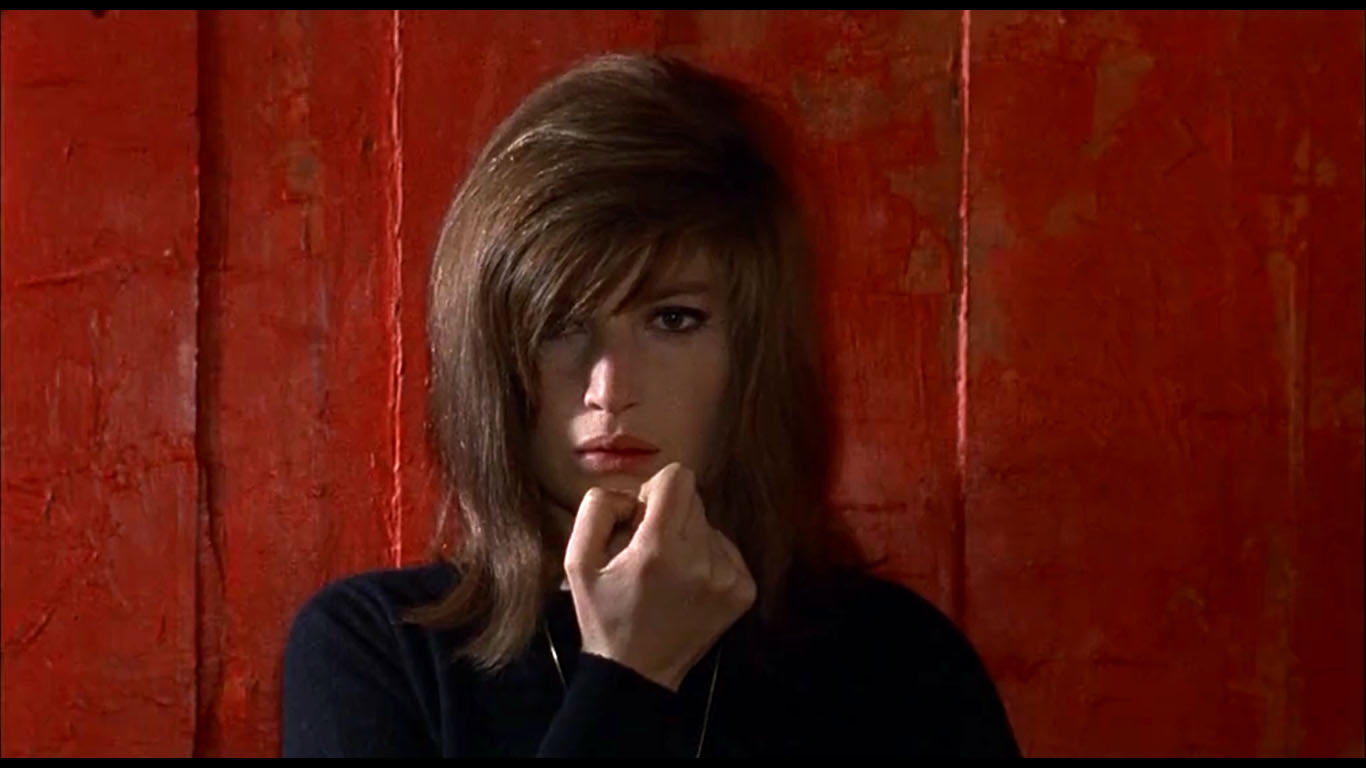
Red Desert


Red Desert: More Fun with Alienation

In the interview of Antonioni, conducted by everyone's favorite nouvelle vague name to drop, Jean-Luc Godard, the director speaks at length about how the industrial wasteland scenes in the film are meant to evoke a sense of wonder and beauty. For a modern viewer it is difficult not to associate the oil slicks and yellow factory smog with anything other than the environmental apocalypse we've been promised by experts is just around the corner. Antonioni goes on to speak about how Monica Vitti's problem in the film, aside from her son's legs going numb--or did they???--from the wonder and beauty of the polluted environment he's mired in, is that she cannot adjust herself to the brave, new world of progress. It amazes me that Antonioni was able to create a film of such stunning cinematic sublimity with such rich, disaffected characters, and yet at the same time maintain an almost naive faith in technological advancements. Thoughts?